
Agent Authority
Faster AI adoption with control over agent actions
Free 14-day trial of Agent Authority
Connect the agents and tools your team already uses, and expand AI use with the controls in place.
- See which agents are active across your systems and what they can reach
- Allow or block each agent request in real time
- A SecureAuth engineer sets up your tenant with you
Works with Claude Code, Cursor, Codex, GitHub Copilot, ChatGPT, Gemini and any MCP-capable agent, with governed access to Slack, GitHub, Atlassian, Microsoft 365, Salesforce and more.
Start your free 14-day trial
Tell us who you are and we'll set up your own Agent Authority tenant.
SecureAuth customers


The Platform
A product tour of the Agent Authority console
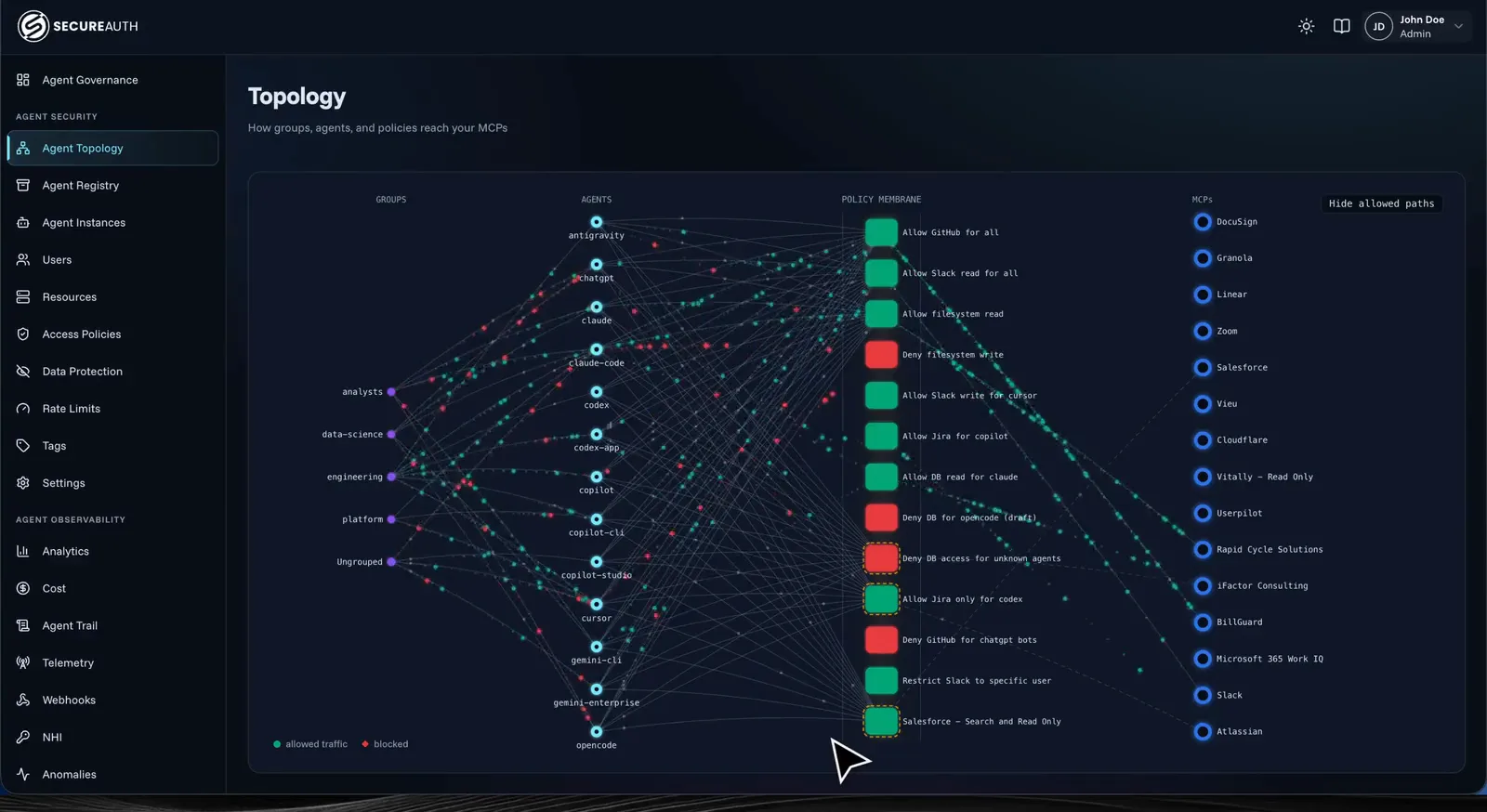
1 / 6Agent topology
The whole estate in one graph
Teams, the agents they run, the policies that decide their calls, and the MCP servers they reach.
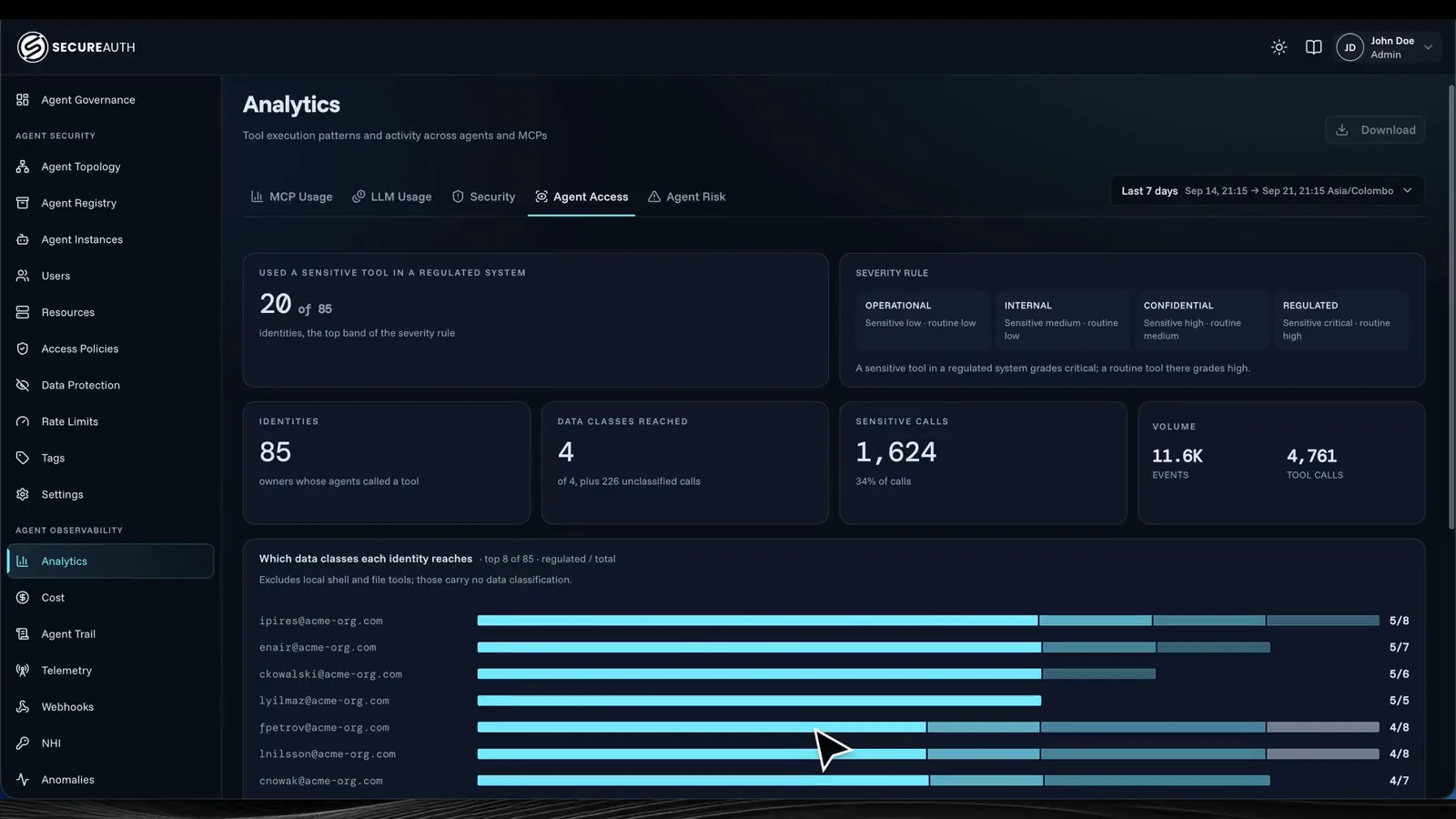
2 / 6Agent reach
What agents actually reach
Which identities touch which data classes, and where the sensitive calls land.
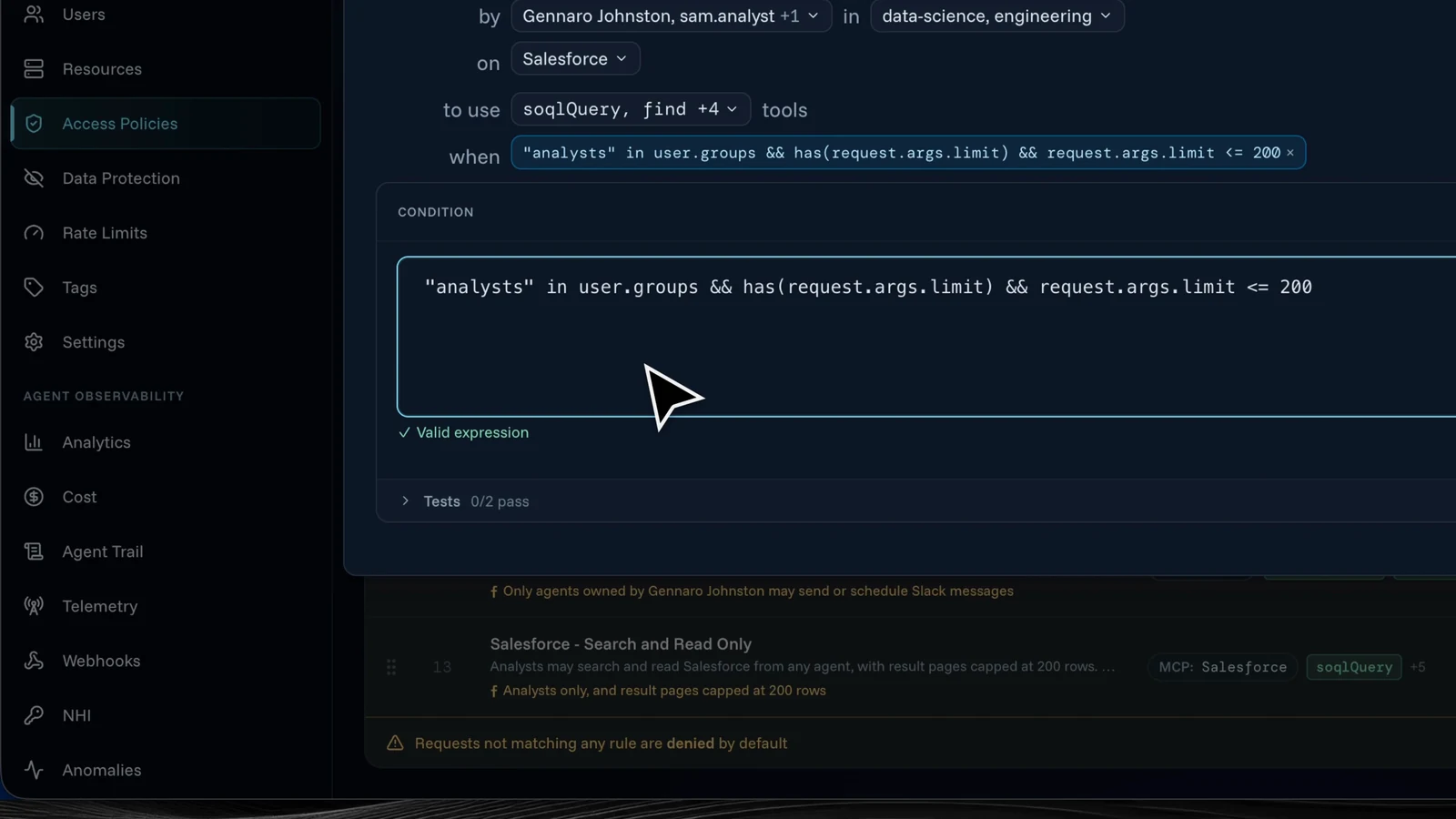
3 / 6Access policies
Policy you can read
Allow or deny by agent, user, group, tool, and condition, with the blast radius shown before you save.
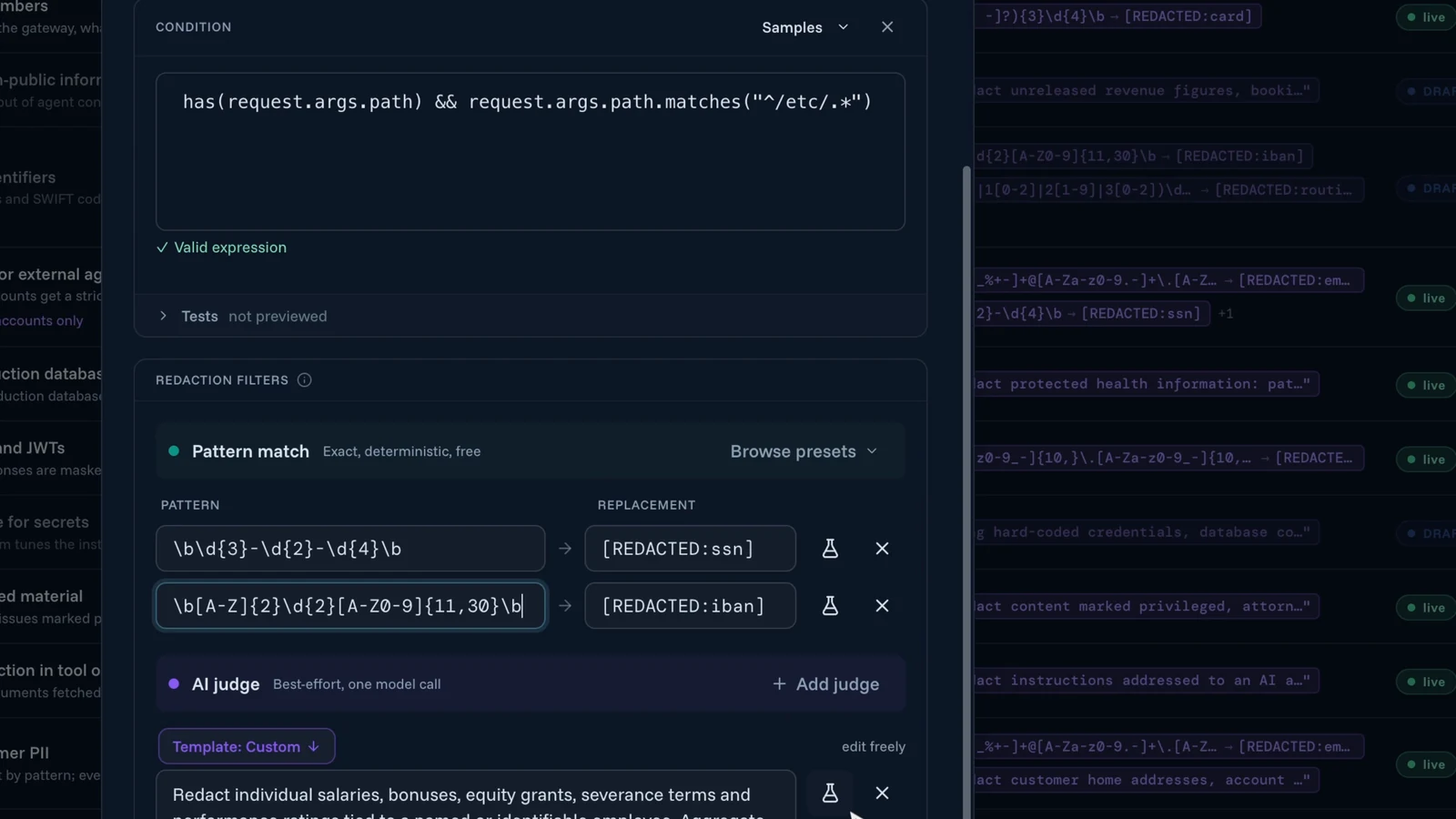
4 / 6Data redaction
Redaction before data leaves
PII, PHI, and MNPI caught in line on the response path, by pattern or by judge.
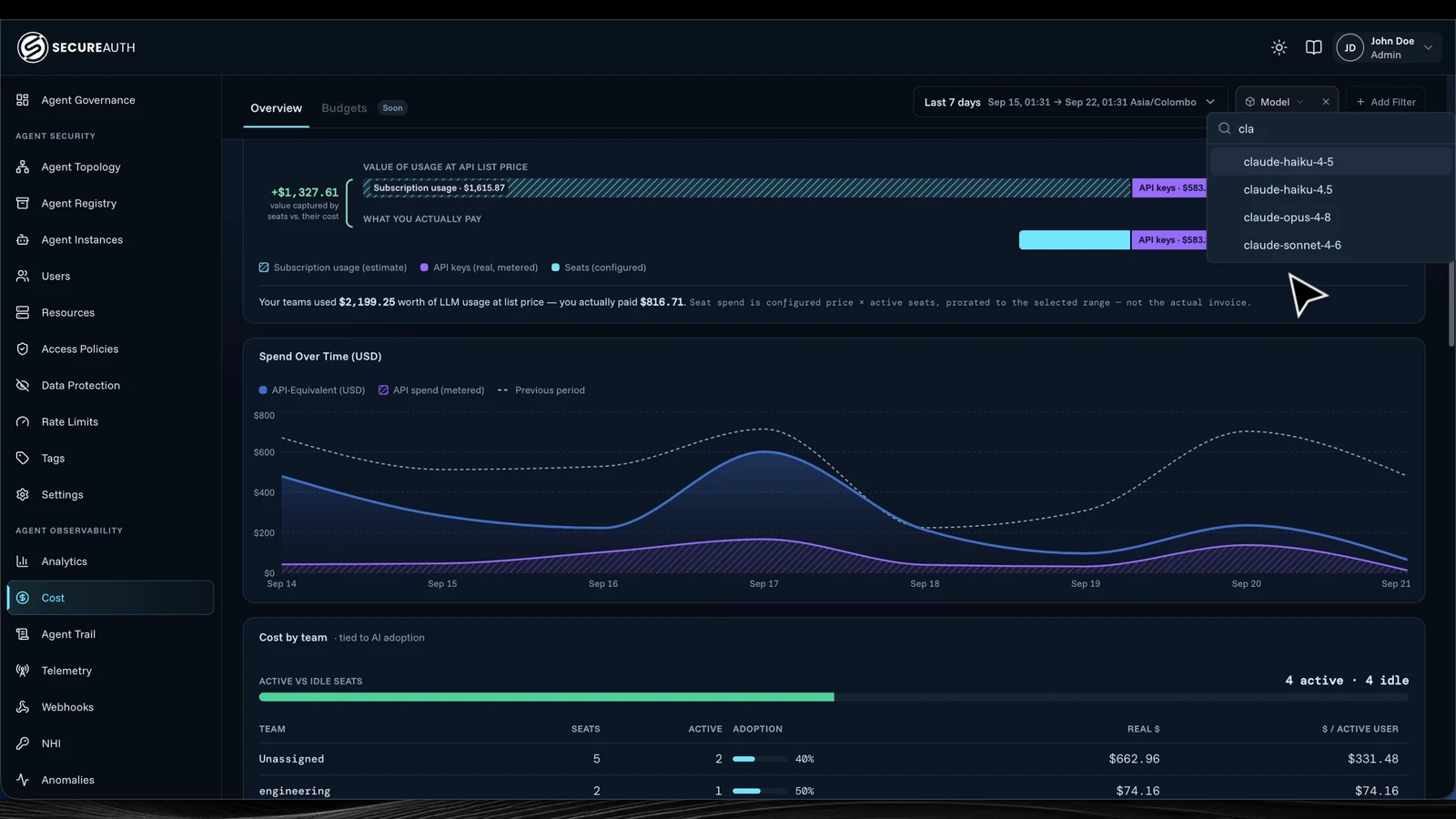
5 / 6Cost and adoption
An owner for agent spend
Cost and seat adoption per team, attributed to the agents that drive them.
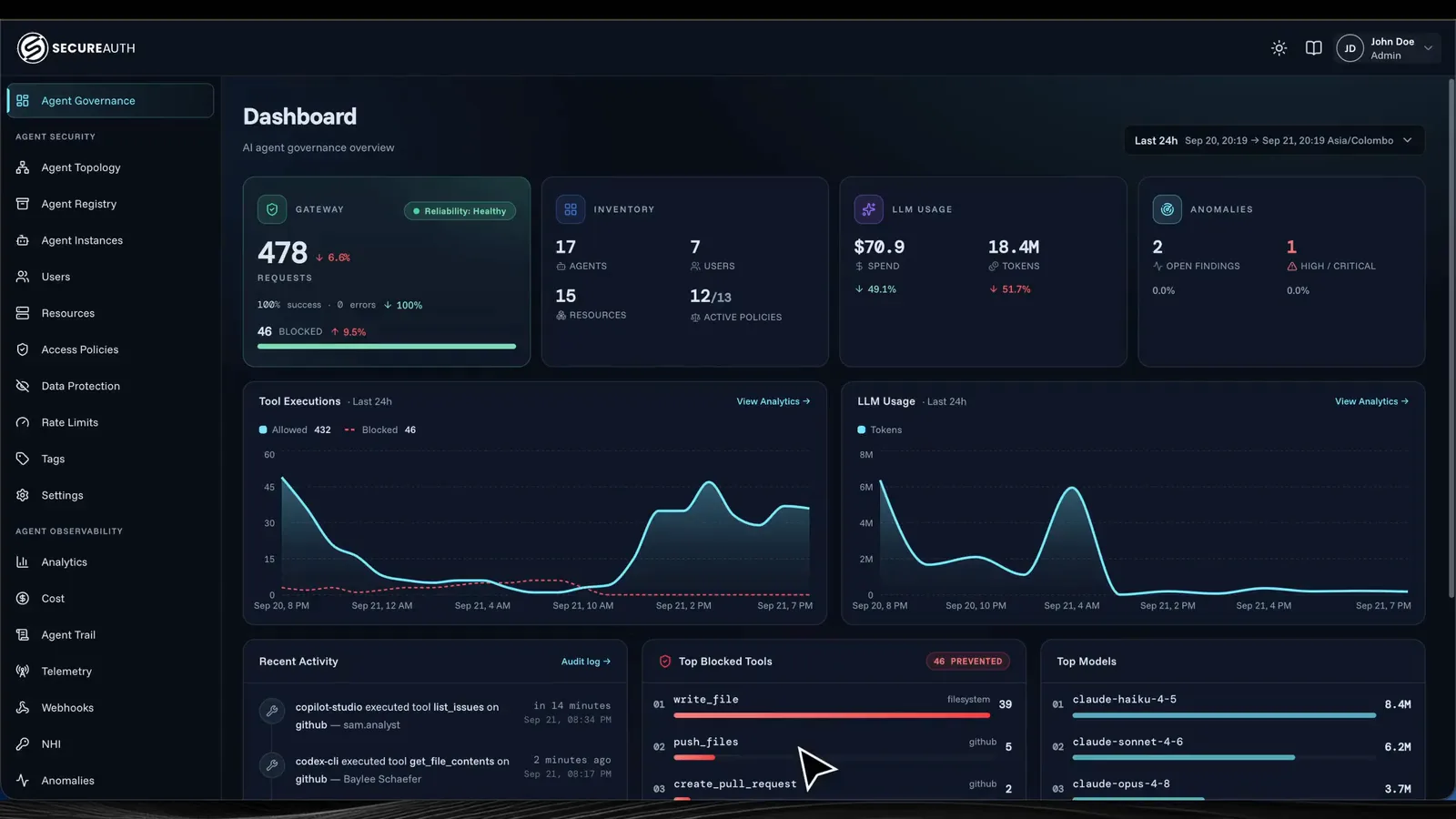
6 / 6Governance
One place to answer for all of it
Requests, blocks, anomalies, and open findings across the whole estate.
Slide 1 of 6: The whole estate in one graph
Integrations
Works with the agents and tools you already use
Your identity provider stays where it is. Your agents keep their vendors. We sit on the call between them. No code changes, no model lock-in.
Identity Providers
SecureAuth, Okta, Ping, Microsoft Entra ID & more. Keep the one you have
Agent Vendors & Models
Claude, ChatGPT, Gemini, Microsoft Copilot, Cursor, Replit & in-house agents
Enterprise Apps & Data
Salesforce, DocuSign, Slack, Microsoft 365, GitHub, Snowflake & more
SIEM, SOAR & XDR
Splunk, CrowdStrike, Datadog, Microsoft Sentinel & more


Connected on secure standards
- OAuth 2.1
- OpenID Connect
- SPIFFE / SVID
- mTLS
- Token exchange
- Model Context Protocol
How it works
Control what each agent can do
The visibility layer
'%20stroke-width='1'%3e%3cpath%20d='M%20170.0%20104.0%20L%2092.1%20149.0'%3e%3c/path%3e%3cpath%20d='M%20170.0%20104.0%20L%20247.9%20149.0'%3e%3c/path%3e%3cpath%20d='M%20183.0%20111.5%20L%20105.0%20156.5'%3e%3c/path%3e%3cpath%20d='M%20157.0%20111.5%20L%20234.9%20156.5'%3e%3c/path%3e%3cpath%20d='M%20196.0%20119.0%20L%20118.0%20164.0'%3e%3c/path%3e%3cpath%20d='M%20144.0%20119.0%20L%20222.0%20164.0'%3e%3c/path%3e%3cpath%20d='M%20209.0%20126.5%20L%20131.0%20171.5'%3e%3c/path%3e%3cpath%20d='M%20131.0%20126.5%20L%20209.0%20171.5'%3e%3c/path%3e%3cpath%20d='M%20222.0%20134.0%20L%20144.0%20179.0'%3e%3c/path%3e%3cpath%20d='M%20118.0%20134.0%20L%20196.0%20179.0'%3e%3c/path%3e%3cpath%20d='M%20234.9%20141.5%20L%20157.0%20186.5'%3e%3c/path%3e%3cpath%20d='M%20105.0%20141.5%20L%20183.0%20186.5'%3e%3c/path%3e%3cpath%20d='M%20247.9%20149.0%20L%20170.0%20194.0'%3e%3c/path%3e%3cpath%20d='M%2092.1%20149.0%20L%20170.0%20194.0'%3e%3c/path%3e%3c/g%3e%3cg%20fill='none'%20stroke='%236898e2'%20stroke-width='1'%3e%3cpath%20d='M%20170.0%20119.0%20L%20170.0%2096.5'%3e%3c/path%3e%3ccircle%20cx='170.0'%20cy='96.5'%20r='2.6'%3e%3c/circle%3e%3cpath%20d='M%20201.2%20131.0%20L%20201.2%20111.5'%3e%3c/path%3e%3ccircle%20cx='201.2'%20cy='111.5'%20r='2.6'%3e%3c/circle%3e%3cpath%20d='M%20216.8%20152.0%20L%20216.8%20128.0'%3e%3c/path%3e%3ccircle%20cx='216.8'%20cy='128.0'%20r='2.6'%3e%3c/circle%3e%3cpath%20d='M%20138.8%20134.0%20L%20138.8%20113.0'%3e%3c/path%3e%3ccircle%20cx='138.8'%20cy='113.0'%20r='2.6'%3e%3c/circle%3e%3cpath%20d='M%20164.8%20143.0%20L%20164.8%20117.5'%3e%3c/path%3e%3ccircle%20cx='164.8'%20cy='117.5'%20r='2.6'%3e%3c/circle%3e%3cpath%20d='M%20185.6%20164.0%20L%20185.6%20144.5'%3e%3c/path%3e%3ccircle%20cx='185.6'%20cy='144.5'%20r='2.6'%3e%3c/circle%3e%3cpath%20d='M%20125.8%20153.5%20L%20125.8%20131.0'%3e%3c/path%3e%3ccircle%20cx='125.8'%20cy='131.0'%20r='2.6'%3e%3c/circle%3e%3cpath%20d='M%20157.0%20165.5%20L%20157.0%20144.5'%3e%3c/path%3e%3ccircle%20cx='157.0'%20cy='144.5'%20r='2.6'%3e%3c/circle%3e%3cpath%20d='M%20172.6%20183.5%20L%20172.6%20159.5'%3e%3c/path%3e%3ccircle%20cx='172.6'%20cy='159.5'%20r='2.6'%3e%3c/circle%3e%3c/g%3e%3cg%20fill='none'%20stroke='%239b6dff'%20stroke-width='1.1'%3e%3cpath%20d='M%20199.9%20149.8%20L%20199.9%20116.8'%20stroke-dasharray='3%203'%3e%3c/path%3e%3cpath%20d='M%20199.9%20112.8%20l%204%204%20l%20-4%204%20l%20-4%20-4%20Z'%3e%3c/path%3e%3ccircle%20cx='199.9'%20cy='149.8'%20r='7'%20stroke-dasharray='2%203'%20stroke-opacity='.55'%3e%3c/circle%3e%3cpath%20d='M%20132.3%20143.8%20L%20132.3%20112.3'%20stroke-dasharray='3%203'%3e%3c/path%3e%3cpath%20d='M%20132.3%20108.3%20l%204%204%20l%20-4%204%20l%20-4%20-4%20Z'%3e%3c/path%3e%3ccircle%20cx='132.3'%20cy='143.8'%20r='7'%20stroke-dasharray='2%203'%20stroke-opacity='.55'%3e%3c/circle%3e%3cpath%20d='M%20138.8%20168.5%20L%20138.8%20134.0'%20stroke-dasharray='3%203'%3e%3c/path%3e%3cpath%20d='M%20138.8%20130.0%20l%204%204%20l%20-4%204%20l%20-4%20-4%20Z'%3e%3c/path%3e%3ccircle%20cx='138.8'%20cy='168.5'%20r='7'%20stroke-dasharray='2%203'%20stroke-opacity='.55'%3e%3c/circle%3e%3c/g%3e%3cg%20style='animation:%20cfSweepX%207s%20cubic-bezier(.16,1,.3,1)%20infinite;'%3e%3cpath%20d='M%20170.0%2098.0%20L%2081.7%20149.0'%20stroke='%2375e7ff'%20stroke-width='1.4'%20style='filter:%20drop-shadow(0%200%208px%20rgba(117,231,255,.8));'%3e%3c/path%3e%3c/g%3e%3c/svg%3e)
See
Every agent, service account, and instance in your systems, including unregistered ones.
Discovered from live traffic, with an owner and a runtime for each.
The observability layer
{.hiw-motion{display:none}}%3c/style%3e%3cdefs%3e%3clinearGradient%20id='hUnd'%20gradientUnits='userSpaceOnUse'%20x1='0'%20y1='34'%20x2='0'%20y2='174'%3e%3cstop%20offset='0%25'%20stop-color='%2375e7ff'%20stop-opacity='.55'%3e%3c/stop%3e%3cstop%20offset='58%25'%20stop-color='%236898e2'%20stop-opacity='.3'%3e%3c/stop%3e%3cstop%20offset='100%25'%20stop-color='%236898e2'%20stop-opacity='0'%3e%3c/stop%3e%3c/linearGradient%3e%3c/defs%3e%3cg%20fill='none'%20stroke='url(%23hUnd)'%20stroke-width='1'%3e%3cpath%20d='M%20170.0%2038.0%20L%20242.7%2080.0%20L%20170.0%20122.0%20L%2097.3%2080.0%20Z'%3e%3c/path%3e%3cpath%20d='M%20170.0%2083.0%20L%20224.6%20114.5%20L%20170.0%20146.0%20L%20115.4%20114.5%20Z'%3e%3c/path%3e%3cpath%20d='M%20170.0%20128.0%20L%20206.4%20149.0%20L%20170.0%20170.0%20L%20133.6%20149.0%20Z'%3e%3c/path%3e%3c/g%3e%3cg%20fill='none'%20stroke='%236898e2'%20stroke-width='1'%20stroke-opacity='.7'%3e%3cpath%20d='M%20170.0%2080.0%20L%20170.0%20149.0'%3e%3c/path%3e%3c/g%3e%3cg%20fill='none'%20stroke='%2375e7ff'%20stroke-width='1.2'%3e%3ccircle%20cx='170.0'%20cy='80.0'%20r='4.4'%3e%3c/circle%3e%3ccircle%20cx='170.0'%20cy='114.5'%20r='3.4'%3e%3c/circle%3e%3ccircle%20cx='170.0'%20cy='149.0'%20r='2.6'%3e%3c/circle%3e%3c/g%3e%3ccircle%20class='hiw-motion'%20r='2.6'%20fill='%2375e7ff'%20style='filter:%20drop-shadow(0%200%207px%20rgba(117,231,255,.95));'%3e%3canimateMotion%20dur='5.5s'%20repeatCount='indefinite'%20calcMode='spline'%20keySplines='0.16%201%200.3%201'%20keyTimes='0;1'%20keyPoints='0;1'%20path='M%20170.0%2080.0%20L%20170.0%20149.0'%3e%3c/animateMotion%3e%3c/circle%3e%3c/svg%3e)
Understand
Who authorized each agent, which user it acts for, and every tool it reached, in one trail.
Behavioral baselines for every action, reach, and cost.
The decision layer
'%20stroke-width='1'%3e%3cpath%20d='M%20216.8%20140.0%20L%20123.2%20194.0%20L%20123.2%20125.0%20L%20216.8%2071.0%20Z'%3e%3c/path%3e%3cpath%20d='M%20193.4%20153.5%20L%20193.4%2084.5'%20stroke-opacity='.5'%3e%3c/path%3e%3cpath%20d='M%20162.2%20171.5%20L%20162.2%20102.5'%20stroke-opacity='.5'%3e%3c/path%3e%3cpath%20d='M%20138.8%20185.0%20L%20138.8%20116.0'%20stroke-opacity='.5'%3e%3c/path%3e%3c/g%3e%3cg%20fill='none'%20stroke='%236898e2'%20stroke-width='1'%3e%3cpath%20d='M%20150.5%2073.3%20L%20197.3%20100.3'%3e%3c/path%3e%3cpath%20d='M%2096.0%20104.8%20L%20142.7%20131.8'%3e%3c/path%3e%3c/g%3e%3cg%20fill='none'%20stroke='%2375e7ff'%20stroke-width='1.3'%3e%3cpath%20d='M%20197.3%20100.3%20L%20244.0%20127.3'%3e%3c/path%3e%3cpath%20d='M%20142.7%20131.8%20L%20189.5%20158.8'%3e%3c/path%3e%3ccircle%20cx='244.0'%20cy='127.3'%20r='2.8'%3e%3c/circle%3e%3ccircle%20cx='189.5'%20cy='158.8'%20r='2.8'%3e%3c/circle%3e%3c/g%3e%3cg%20fill='none'%20stroke='%23f24b6b'%20stroke-width='1.2'%3e%3cpath%20d='M%20123.2%20105.5%20L%20170.0%20132.5'%20stroke-dasharray='4%203'%3e%3c/path%3e%3cpath%20d='M%20166.0%20128.5%20l%208%208%20M%20174.0%20128.5%20l%20-8%208'%20stroke-linecap='round'%3e%3c/path%3e%3c/g%3e%3cpath%20d='M%20216.8%2071.0%20L%20123.2%20125.0'%20fill='none'%20stroke='%2375e7ff'%20stroke-width='1.4'%20stroke-opacity='.8'%20style='filter:%20drop-shadow(0%200%209px%20rgba(117,231,255,.65));'%3e%3c/path%3e%3c/svg%3e)
Control
Every action agents take, decided in real time before they can do anything.
One decision per action, in milliseconds.
FAQ
Trial questions
14 days, counted from the day your tenant is set up. It is your own tenant, not a shared sandbox, and the trial is free.
It sits inline: every tool call passes through the gateway and gets an allow or deny decision before it runs. A new tenant starts with a single Allow all rule, so in practice you begin observe-first: agents keep working, every call is recorded in the Agent Trail, and you tighten the rules once you have seen what your agents actually reach. There is no mirror-only mode where calls bypass the gateway.
For each call it records structured metadata: the timestamp, the user and agent instance, the action, the resource and tool, the policy decision, and the request context. It does not store the prompts or responses of the agent's conversation with its model. Tool responses pass through unchanged unless you switch on a Data Protection filter, and a redacted call records only which rule matched and how many values it replaced, never the values themselves. Audit events are kept for three months, and webhooks can forward them to your own systems.